
“Putting our feelings into words is a way of taking down the walls that hide our fragility from the world and from ourselves.
A way of transcending these walls. When the pain is no long invisible, hidden away to be nursed and ruminated on,
It’s free to become something else, something authentic and meaningful.”
p 147, The Feeling of Cancer
Five months on from publishing my book, I am more passionate than ever about raising awareness of understanding our feelings in the face of all that cancer throws. It is central to our ongoing wellbeing. The whole of The Feeling of Cancer is an exploration and excavation of my feeling states through diagnosis, treatment, remission and relapse over a period of six years. However, I want to say more about why I think feelings warrant so much attention.
THE IMPORTANCE OF FEELINGS
In general terms, feelings are a key part of the mind/body system. They affect how we think and how we behave, and they also greatly affect our health, both mental and physical. When we are out of sync with our feeling states they take over and we can feel that we are travelling through life being reactive, rigid or disconnected.
However, how we experience and express our feelings is cultural, related to family environment as well as the wider society, and is then shaped by our life, work and relationships. In my psychotherapy practice, people who came to me for help were either feeling overwhelmed by their feelings or finding it difficult to feel very much at all. They had too many feelings or had shut their feelings off.
When we are emotionally well, we are aware of our feelings, understand why we are feeling them and are able to manage them in a way that is helpful for us and those around us. This does not mean that we do not have painful feelings, because those are an inevitable part of life, but it does mean that we are able to make sense of those feelings and find healthy ways to cope with them.
It was often the case that when I asked people how they were feeling they struggled to find the words. In the therapy we would work together to try to understand and manage the crisis they were experiencing and the key to this process was building up enough trust in the relationship to both identify and feel the feelings. The phrase “I’m not feeling myself” takes on a deeper meaning.
FEELINGS ARE CENTRAL TO WHO WE ARE
The emotional self is a key driver in our lives and a foundation of our identity. Our capacity to tune into our own feelings and understand how they affect us is vital to our ability to be both vulnerable and resilient, as well as manage our self-care. Being connected to our feelings is being connected to the self and to our truth in any situation. So being tuned into our emotions provides us with crucial information about how we are and what we need.
Understanding our feelings helps us to make sense of difficult situations happening in our lives, and find our place, whilst lowering the intensity. Supressing our feelings may be the only way to survive, but over time supressing them does not mean they go away. They sit inside us and come back to us, looking to be resolved in some way.
FEELINGS ARE PERSONAL
We each have our own personal emotional footprint and although there are universal feelings, how we each feel about what is happening to us is deeply personal. There is so much general advice, particularly online, on how to manage feelings, advice that tends to put us all in the same categories and makes assumptions about how we “should” feel and what feelings are “acceptable”.
But we know inside ourselves when we feel emotionally settled and connected to ourself and the outside world. This changes over time and tuning into our emotional self an ongoing process in life. But the whole landscape and process of cancer throws all of this off-kilter.
Which brings me to cancer.
CANCER AND FEELINGS
“Our bodies provide us with the signals for our feelings, and much of this happens out of our awareness. Now, for me, the signals, when they’re not down completely) are receiving interference. This interference is a force field of anxiety around me”
p. 22
I’ve chosen this passage from from the third chapter, The Traumatic Nature of Cancer, to show how the traumatic experience of diagnosis and beginning treatment within a couple of weeks affected me. Being diagnosed with cancer may be the most frightening and destabilizing event to happen in our life. It was for me.
Even with all my psychotherapy experience, I found that putting words to the feelings at such a time of enormous emotional stress and turmoil was very difficult. Feelings are felt in the body and when the body is under attack, we go into survival mode. So it may only be after the initial storm has abated that we are able to begin to feel our feelings. It can be surprising, when you look closely at a feeling wheel, just how many feelings we are shutting out or unaware of, not just when we are struggling, but in everyday life. The feeling wheel is a useful tool to remind how rich our feeling life can be when we pay attention to it.
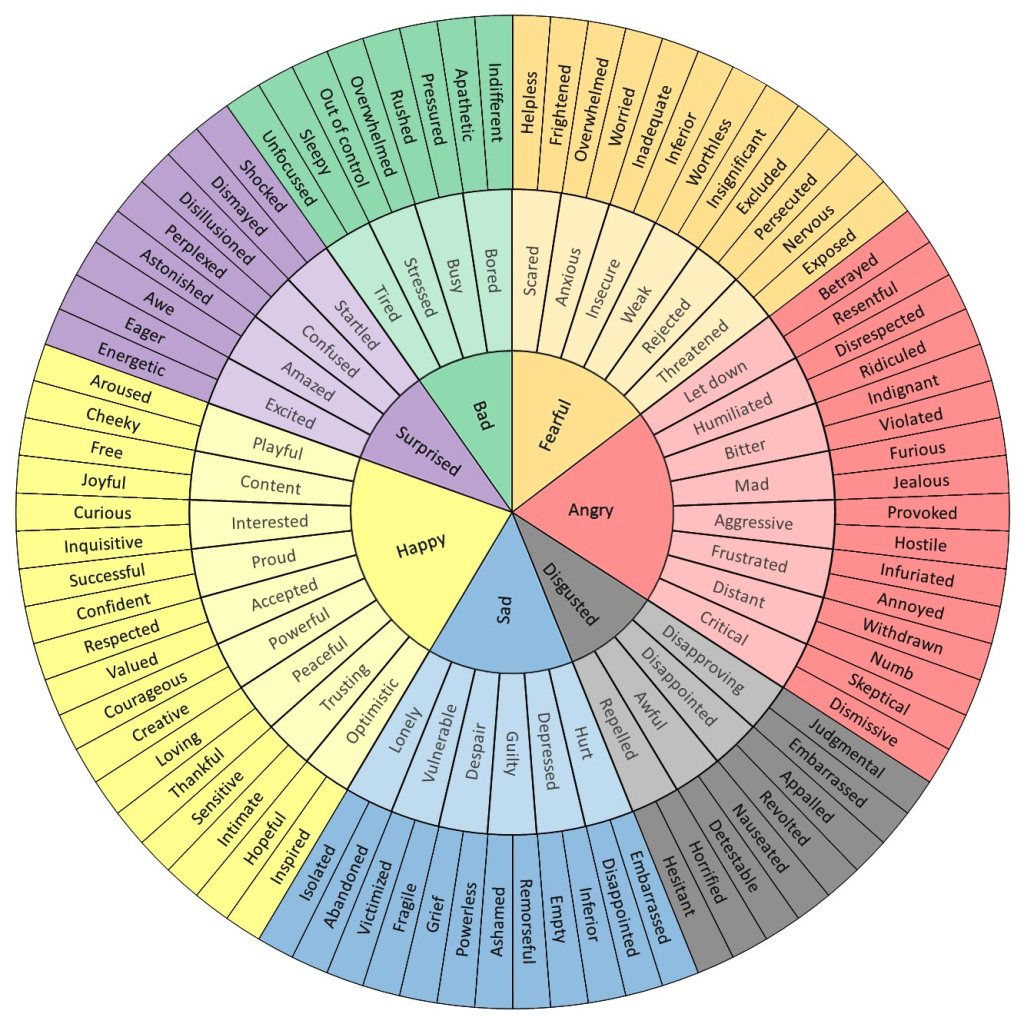
External pressure also plays a part in preventing us from expressing our feelings. We have to “be strong” and “keep it together” for everyone around us. I felt that others were watching me to see how I was coping and it was important to keep my awful feelings to myself much of the time. So I know from experience how emotional stress is difficult to be open about and express authentically, especially where traumatic feelings are involved. But I also know how important it is for our emotional wellbeing that we are able to recognise them in ourself.
The way to do this at these difficult times is to make the space and time to connect with our feelings. This is a process of healing. An important one, as feelings provide us with information to navigate through life’s course.
This process is described in this extract is from Living with Uncertainly, a chapter where I am struggling to recover from almost dying of pneumonia in the Intensive Care Unit.
“I need to focus on nurturing my inner self. The only thing that helps is being still and quiet. When I have space and times to myself…in the body that feels like a shell…I can breathe life back into my inner world, my emotional life, and hope that everything else will begin to fall into place”
p. 100
Becoming empathic and accepting towards your own feelings is at the heart of managing change.
 thefeelingofcancer.com